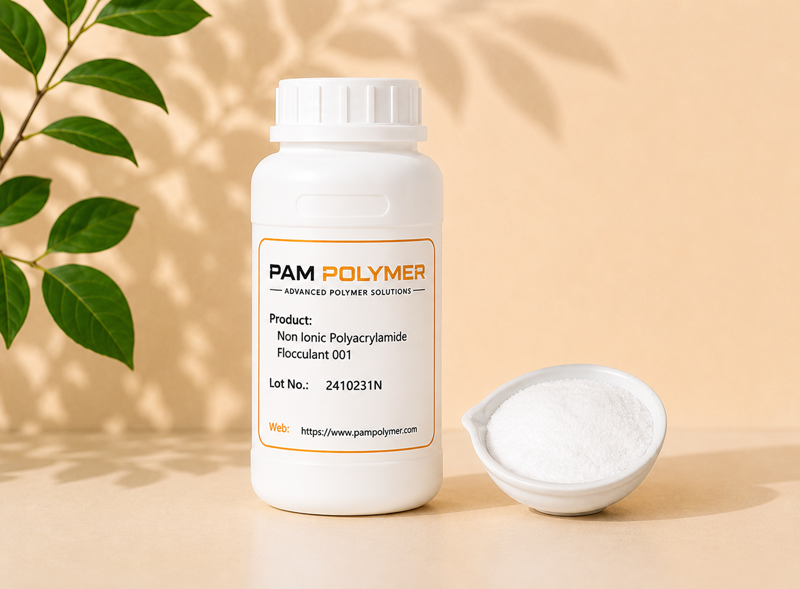


PAMPolymer’s nonionic flocculant have excellent performance in industrial wastewater treatment and mining processes. Get convinced now. PAMPolymer nonionic flocculants are technically pure polyacrylamides. Nonionic polyacrylamide exhibits neutral nonionic properties in the aqueous solution which is hardly influenced by the PH value in the application. PAMPolymer nonionic flocculants are suitable for use as a settlement aid in many different mineral-processing applications and are particularly effective under very low PH conditions, as encountered in acidic leach operations. Main Specifications of Non ionic Polyacrylamide (PAM) Products Product Code Molecular Weight Nonionic PAM Powder PAMPolymer 9010 Medium Nonionic PAM Powder PAMPolymer 9010H High Dosage and Feeding of Dry PAM The solutions of PAMPolymer nonionic PAM must be prepared in suitable plants equipped with dry powders feeding and dispersion units and with continuous and moderate agitation. The dissolution water must have a temperature included between 10% and 40%; For a correct use of PAMPolymer nonionic polyelectrolyte and in order to achieve the best possible results, it is necessary to allow a "maturation" time of 60 minutes. When treating turbid water, the flocculants solution must be added to the water in a point of average turbulence, in
Grade: Medium molecular weight nonionic PAM
Main use: acidic wastewater and general settlement assistance
PAMPolymer's nonionic flocculant have excellent performance in industrial wastewater treatment and mining processes. Get convinced now. PAMPolymer nonionic flocculants are technically pure polyacrylamides. Nonionic polyacrylamide exhibits neutral nonionic properties in the aqueous solution which is hardly influenced by the PH value in the application. PAMPolymer nonionic flocculants are suitable for use as a settlement aid in many different mineral-processing applications and are particularly effective under very low PH conditions, as encountered in acidic leach operations. Main Specifications of Non ionic Polyacrylamide (PAM) Products Product Code Molecular Weight Nonionic PAM Powder PAMPolymer 9010 Medium Nonionic PAM Powder PAMPolymer 9010H High Dosage and Feeding of Dry PAM The solutions of PAMPolymer nonionic PAM must be prepared in suitable plants equipped with dry powders feeding and dispersion units and with continuous and moderate agitation. The dissolution water must have a temperature included between 10% and 40%; For a correct use of PAMPolymer nonionic polyelectrolyte and in order to achieve the best possible results, it is necessary to allow a "maturation" time of 60 minutes. When treating turbid water, the flocculants solution must be added to the water in a point of average turbulence, in order to achieve a thorough and homogeneous mixing without impairing the flock formation. Recommend operating concentration is 3g/l, and the maximum operating concentration is 15g/l. For an optimum performance
| Product Category | Non Ionic Polyacrylamide Flocculant |
| Formula / Type | (C3H5NO)n nonionic polymer |
| CAS No. | 9003-05-8 |
| Grade | Medium molecular weight nonionic PAM |
| Appearance | white granular powder |
| Application | acidic wastewater and general settlement assistance |
| Packaging | 25 kg multi-layer bags |
Products | Product Code | Molecular Weight |
Nonionic PAM Powder | PAMPolymer 9010 | Medium |
Nonionic PAM Powder | PAMPolymer 9010H | High |
PAMPolymer's nonionic flocculant have excellent performance in industrial wastewater treatment and mining processes. Get convinced now.
PAMPolymer nonionic flocculants are technically pure polyacrylamides. Nonionic polyacrylamide exhibits neutral nonionic properties in the aqueous solution which is hardly influenced by the PH value in the application. PAMPolymer nonionic flocculants are suitable for use as a settlement aid in many different mineral-processing applications and are particularly effective under very low PH conditions, as encountered in acidic leach operations.
Products | Product Code | Molecular Weight |
Nonionic PAM Powder | PAMPolymer 9010 | Medium |
Nonionic PAM Powder | PAMPolymer 9010H | High |
The solutions of PAMPolymer nonionic PAM must be prepared in suitable plants equipped with dry powders feeding and dispersion units and with continuous and moderate agitation. The dissolution water must have a temperature included between 10% and 40%; For a correct use of PAMPolymer nonionic polyelectrolyte and in order to achieve the best possible results, it is necessary to allow a "maturation" time of 60 minutes. When treating turbid water, the flocculants solution must be added to the water in a point of average turbulence, in order to achieve a thorough and homogeneous mixing without impairing the flock formation. Recommend operating concentration is 3g/l, and the maximum operating concentration is 15g/l. For an optimum performance on specific applications on nonionic flocculant, please consult with PAMPolymer team.
Above is only a brief introduction and regular specifications. For more technical details (Technical Data Sheet, Material Safety Data Sheet, Certificate of Analysis etc.) or any customized specifications, please contact us.
PAMPolymer is supplying dry powder flocculants with charge under 5%.
Our nonionic polymer flocculants is amorphous, free-flowing powder, with Molecular Weight: 5 to 15 million.
Sionfloc nonionic polyacrylamide is available in solid status.
Nonionic Flocculants is widely used in industrial wastewater treatment, mineral process, paper making and other industries.
The nonionic polyacrylamide (PAM) has strong flocculation effect as it has good performance in clarifying & purification, settlement promotion, filtering promotion and thickening. All this makes good application in wastewater treatment, sludge concentration and dehydration, mineral processing, coal washing, paper making, etc..
PAMPolymer nonionic polyacrylamide has good water solubility even in cold water. Moreover nonionic polyacrylamide can be greatly flocculated under a small dosage like 0.01~10ppm. And our nonionic polymer shows a great performance when joint using with inorganic flocculant like polymerized ferric sulfate, poly aluminum chloride, and iron salt.
PAMPolymer Polymers could be used as paper strength agent, retention aid and filter aid in paper making. It can greatly improve the quality of paper, save costs and improve the production capacity of paper mills. Our nonionic polymers could be work with inorganic salt ions, fiber and other organic polymer in order to enhance the physical strength of the paper, and also reduce the loss of fiber or filler. It also has good performance to accelerate filter water, strengthening, retention and drainage effect.
Nonionic polyacrylamide is widely applied in the field of building materials as an external additive for concrete, which can improve the interaction between concrete particles and thereby the strength and toughness of concrete is increased. The application of nonionic polyacrylamide in building materials has been widely promoted owing to its role of flocculation, water holding, thickening, adhesion and lubrication. In addition, non-ionic polyacrylamide in other building materials, because of its ultra-high viscosity and its special molecular structure, has good water retention effect. The most common use is as a thickening agent for putty powder, refractory binder, mortar thickening water retention agent.
Nonionic flocculants can be used in dyeing wastewater treatment to make most of the non-water soluble dye particles and colloidal organic matter condensed into large particles and then removal through natural sedimentation, flotation.
It's more appropriate to use nonionic polyacrylamide as flocculants when the suspension of sewage is acidic. The suspending particles produce flocculation to purify water. When used in the city sewage, food processing waste water treatment, sludge dewatering, the positive charge could have neutralize effect with negative sludge groups in organic gel. Through high polymer excellent bridging condensed function, colloidal particles aggregate into large floc and separate from the suspension.
Nonionic Polyacrylamide could be used in sand prevention and sand fixation through spraying on desert with dissolving nonionic polyacrylamide concentration and crosslinking agent. This product could also be used as soil moisturizer and the basic raw materials for various modified polyacrylamide.
Polyacrylamide is most commonly used as flocculants, abbreviated as PAM. Flocculants is the linear polymer. Besides polyacrylamide solid aluminum sulfate, liquid aluminum sulfate, alum, polyaluminum chloride, ferric chloride, ferrous sulfates are also used as flocculants.
First, select a well-ventilated and dry warehouse, and to reduce the time of sunlight as the sun exposure will make polyacrylamide molecular weight degradation. Moisturizing polyacrylamide is easily to agglomerate and hard to dissolve as an aqueous solution during dissolution. If in a solution case, after the polyacrylamide dissolved in aqueous solution not used up, the remaining polyacrylamide solution should be filled with a lid seal to prevent dust from entering. The storage time of polyacrylamide is 48 hours. The solution becomes thinner when the polyacrylamide solution is stored for an extended period of time.
PAMPolymer technical team could provide in-house testing and lab facilities to optimize products performance with the best combination of flocculants in your conditions.
As one of the top polyacrylamide suppliers, PAMPolymer has the ability and experience to ship our flocculants to any port in the world. Door to door practice is also available.
Send your required grade, application, packaging, quantity and destination port. PAMPolymer will reply with product details and export pricing.



PAMPolymer’s nonionic flocculant have excellent performance in industrial wastewater treatment and mining processes. Get convinced now. PAMPolymer nonionic flocculants are technically pure polyacrylamides. Nonionic polyacrylamide exhibits neutral nonionic properties in the aqueous solution which is hardly influenced by the PH value in the application. PAMPolymer nonionic flocculants are suitable for use as a settlement aid in many different mineral-processing applications and are particularly effective under very low PH conditions, as encountered in acidic leach operations. Main Specifications of Non ionic Polyacrylamide (PAM) Products Product Code Molecular Weight Nonionic PAM Powder PAMPolymer 9010 Medium Nonionic PAM Powder PAMPolymer 9010H High Dosage and Feeding of Dry PAM The solutions of PAMPolymer nonionic PAM must be prepared in suitable plants equipped with dry powders feeding and dispersion units and with continuous and moderate agitation. The dissolution water must have a temperature included between 10% and 40%; For a correct use of PAMPolymer nonionic polyelectrolyte and in order to achieve the best possible results, it is necessary to allow a "maturation" time of 60 minutes. When treating turbid water, the flocculants solution must be added to the water in a point of average turbulence, in order to achieve a thorough and homogeneous mixing without impairing the flock formation. Recommend operating concentration is 3g/l, and the maximum operating concentration is 15g/l. For an optimum performance on specific applications on nonionic flocculant, please consult with PAMPolymer team. Above is only a brief introduction and regular specifications. For more technical details (Technical Data Sheet, Material Safety Data Sheet, Certificate of Analysis etc.) or any customized specifications, please contact us. FAQ Q What is the Charge of PAMPolymer Nonionic Polyacrylamide? A PAMPolymer is supplying dry powder flocculants with charge under 5%. Q What is the Main Characteristics of PAMPolymer Nonionic Polymer? A Our nonionic polymer flocculants is amorphous, free-flowing powder, with Molecular Weight: 5 to 15 million. Q What Kinds of Nonionic Polyacrylamide are Available in PAMPolymer?