
PAMPolymer is a leading cationic polyacrylamide flocculant factory in China. Click here to buy high-quality cationic polyacrylamide powder. We also introduce the detailed cationic polyacrylamide applications, such as the application for paper making and used in oil & gas industry. Bulk cationic polymer polyacrylamide for sale. PAMPolymer cationic flocculants are co-polymers of acrylamide with increasing proportions of cationic monomers. The cationic groups, which are thus introduced into the polymer, have positive charges in aqueous solution. Our cationic polyacrylamide is available in solid powder and emulsion forms. Main Specifications of Cationic Polyacrylamide (PAM) Products Product Code Cationic Charge Molecular Weight Cationic PAM Powder PAMPolymer 605 Slight High Cationic PAM Powder PAMPolymer 606 Slight Very High Cationic PAM Powder PAMPolymer 610 Low High Cationic PAM Powder PAMPolymer 611 Low Very High Cationic PAM Powder PAMPolymer 615 Low High Cationic PAM Powder PAMPolymer 616 Low Very High Cationic PAM Powder PAMPolymer 620 Low/Medium High Cationic PAM Powder PAMPolymer 621 Low/Medium Very High Cationic PAM Powder PAMPolymer 622 Low/Medium Ultra High Cationic PAM Powder PAMPolymer 625 Low/Medium High Cationic PAM Powder PAMPolymer 626 Low/Medium Very High Cationic PAM Powder PAMPolymer 630 Medium High Cationic
Grade: Water treatment polymer monomer
Main use: cationic flocculant manufacture
PAMPolymer is a leading cationic polyacrylamide flocculant factory in China. Click here to buy high-quality cationic polyacrylamide powder. We also introduce the detailed cationic polyacrylamide applications, such as the application for paper making and used in oil & gas industry. Bulk cationic polymer polyacrylamide for sale. PAMPolymer cationic flocculants are co-polymers of acrylamide with increasing proportions of cationic monomers. The cationic groups, which are thus introduced into the polymer, have positive charges in aqueous solution. Our cationic polyacrylamide is available in solid powder and emulsion forms. Main Specifications of Cationic Polyacrylamide (PAM) Products Product Code Cationic Charge Molecular Weight Cationic PAM Powder PAMPolymer 605 Slight High Cationic PAM Powder PAMPolymer 606 Slight Very High Cationic PAM Powder PAMPolymer 610 Low High Cationic PAM Powder PAMPolymer 611 Low Very High Cationic PAM Powder PAMPolymer 615 Low High Cationic PAM Powder PAMPolymer 616 Low Very High Cationic PAM Powder PAMPolymer 620 Low/Medium High Cationic PAM Powder PAMPolymer 621 Low/Medium Very High Cationic PAM Powder PAMPolymer 622 Low/Medium Ultra High Cationic PAM Powder PAMPolymer 625 Low/Medium High Cationic PAM Powder PAMPolymer 626 Low/Medium Very High Cationic PAM Powder PAMPolymer 630 Medium High Cationic PAM Powder PAMPolymer 631 Medium Very High Cationic PAM Powder PAMPolymer 635 Medium High Cationic PAM Powder PAMPolymer 636 Medium Very High Cationic PAM Powder PAMPolymer 640 Medium High
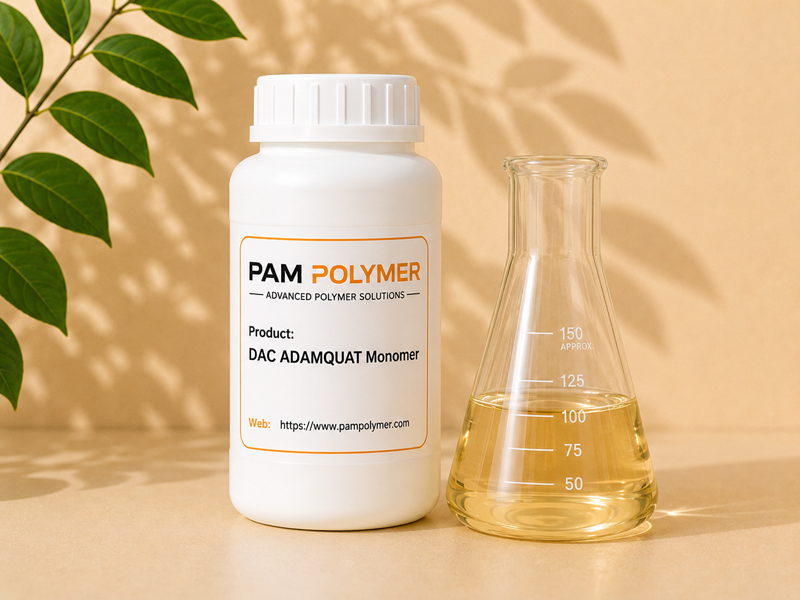
| Product Category | DAC ADAMQUAT Monomer |
| Formula / Type | Acryloyloxyethyltrimethylammonium chloride |
| CAS No. | 44992-01-0 |
| Grade | Water treatment polymer monomer |
| Appearance | clear aqueous solution |
| Application | cationic flocculant manufacture |
| Packaging | drums or IBC tanks |
PAMPolymer is a leading cationic polyacrylamide flocculant factory in China. Click here to buy high-quality cationic polyacrylamide powder. We also introduce the detailed cationic polyacrylamide applications, such as the application for paper making and used in oil & gas industry. Bulk cationic polymer polyacrylamide for sale.
PAMPolymer cationic flocculants are co-polymers of acrylamide with increasing proportions of cationic monomers. The cationic groups, which are thus introduced into the polymer, have positive charges in aqueous solution. Our cationic polyacrylamide is available in solid powder and emulsion forms.
Products | Product Code | Cationic Charge | Molecular Weight |
Cationic PAM Powder | PAMPolymer 605 | Slight | High |
Cationic PAM Powder | PAMPolymer 606 | Slight | Very High |
Cationic PAM Powder | PAMPolymer 610 | Low | High |
Cationic PAM Powder | PAMPolymer 611 | Low | Very High |
Cationic PAM Powder | PAMPolymer 615 | Low | High |
Cationic PAM Powder | PAMPolymer 616 | Low | Very High |
Cationic PAM Powder | PAMPolymer 620 | Low/Medium | High |
Cationic PAM Powder | PAMPolymer 621 | Low/Medium | Very High |
Cationic PAM Powder | PAMPolymer 622 | Low/Medium | Ultra High |
Cationic PAM Powder | PAMPolymer 625 | Low/Medium | High |
Cationic PAM Powder | PAMPolymer 626 | Low/Medium | Very High |
Cationic PAM Powder | PAMPolymer 630 | Medium | High |
Cationic PAM Powder | PAMPolymer 631 | Medium | Very High |
Cationic PAM Powder | PAMPolymer 635 | Medium | High |
Cationic PAM Powder | PAMPolymer 636 | Medium | Very High |
Cationic PAM Powder | PAMPolymer 640 | Medium | High |
Cationic PAM Powder | PAMPolymer 641 | Medium | Very High |
Cationic PAM Powder | PAMPolymer 642 | Medium | Ultra High |
Cationic PAM Powder | PAMPolymer 645 | Medium | High |
Cationic PAM Powder | PAMPolymer 646 | Medium | Very High |
Cationic PAM Powder | PAMPolymer 650 | Medium | High |
Cationic PAM Powder | PAMPolymer 651 | Medium | Very High |
Cationic PAM Powder | PAMPolymer 660 | Medium/Strong | High |
Cationic PAM Powder | PAMPolymer 661 | Medium/Strong | Very High |
Cationic PAM Powder | PAMPolymer 662 | Medium/Strong | Ultra High |
Cationic PAM Powder | PAMPolymer 670 | Strong | High |
Cationic PAM Powder | PAMPolymer 671 | Strong | Very High |
Cationic PAM Powder | PAMPolymer 676 | Strong | Ultra High |
Cationic PAM Powder | PAMPolymer 680 | Very Strong | High |
Cationic PAM Powder | PAMPolymer 681 | Very Strong | Very High |
Cationic PAM Powder | PAMPolymer 691 | Very Strong | Very High |
Cationic PAM Emulsion | PAMPolymer 1209 | Low | High |
Cationic PAM Emulsion | PAMPolymer 1409 | Medium | High |
Cationic PAM Emulsion | PAMPolymer 1509 | Medium/Strong | High |
Cationic PAM Emulsion | PAMPolymer 1809 | Very Strong | High |
Cationic PAM Emulsion | PAMPolymer 260C | Strong | High |
Cationic PAM Emulsion | PAMPolymer 280C | Very Strong | High |
Oil-free Dispersion | PAMPolymer 450W | Medium | High |
Oil-free Dispersion | PAMPolymer 470W | Strong | High |
The polyacrylamide is a synthetic cationic polymerization flocculants and polymer flocculant powder. It is mainly related to chain length and the charge of the dewatering performance of polyacrylamide excessive dosage. The positive charge on the ion polyacrylamide adsorption, due to electrostatic repulsion, it will reduce the sludge settling performance. Therefore, we should pay attention to investment in overtime to calculate in advance the proper dosage. The solutions of PAMPolymer cationic polyacrylamide for chemical applications must be prepared in suitable plants equipped with dry powders feeding and dispersion units and with continuous and moderate agitation. The dissolution water must have a temperature included between 10% and 40%; For a correct use of PAMPolymer cationic polyelectrolyte and in order to achieve the best possible results, it is necessary to allow a "maturation" time of 60 minutes for the coagulation of water. When treating turbid water, the flocculants solution must be added to the water in a point of average turbulence, in order to achieve a thorough and homogeneous mixing without impairing the flock formation. Recommend operating concentration is 3g/l, and the maximum operating concentration is 15g/l.
Above is only a brief introduction and regular specifications. For more technical details (Technical Data Sheet, Material Safety Data Sheet, Certificate of Analysis etc.) or any customized specifications, please contact us.
PAMPolymer is supplying cationic polyacrylamide powder flocculants with cationic charge ranging from 0-100%.
Our cationic polyacrylamide flocculants is amorphous, free-flowing powder, with Molecular Weight: 1 to 15 million.
Cationic Flocculants is widely used in sludge thickening, dewatering and municipal wastewater treatment, paper making and oil & gas process.
To make the 0.3% solution, weigh 1.200g of polyacrylamide powder accurately and add into 400ml of water in a 600ml beaker. The mixer motor must be capable of maintaining 800-1000 rpm to increase the solution viscosity for 30-35 minutes. The finished solution should be clear and homogeneous.
Cationic polyacrylamide is mainly used in high speed centrifuge, belt filter press, plate frame filter machine and other special sewage machines. Cationic polyacrylamide has good effect in the formation of floc speed, extrusion resistance and shear, easier to peel and filter cloth and other characteristics. So it is with high dehydration rate, low moisture content of filter cake, use rarely, can be very good to help customers reduce the cost in use can be used, hydrochloric acid, sulfuric acid concentration in the liquid when used in separation and purification containing suspended substance. Because of its unique chemical and physical properties, it has made a wide use of the effect. Therefore, the actual use of this is widely applied to the sludge dewatering treatment of urban sewage treatment plants, breweries, food factories, tanneries, petrochemical plants, oil fields, metallurgy, chemical industry and cosmetics.
When polyacrylamide used for flocculation, the polyacrylamide molecular chain is fixed on the surface of different particles, and the particles of each particle form a polymer bridge to make the particles form aggregates and settle. And charge group particles on the polyacrylamide molecule could have surface adsorption effect.
It mainly depends on the nature of water treated. If the impurities in the water particles larger, and with a certain charge, then the treatment performance of cationic polyacrylamide alone sometimes is good. If the impurities particles are small and non-charged, then it shall be added inorganic flocculants first and then add cationic polyacrylamide powder. An experiment is usually taken before answer this question. Without adding inorganic flocculants, add polyacrylamide directly to see if the impurities in the water flocculation can be flocculated. If the flocculation of water can clarify, then there is no need to add inorganic flocculants. If not then it should be used with inorganic flocculants.
Polyacrylamide is most commonly used as flocculants, abbreviated as PAM. Flocculants is the linear polymer. Besides polyacrylamide solid aluminum sulfate, liquid aluminum sulfate, alum, polyaluminum chloride, ferric chloride, ferrous sulfates are also used as flocculants.
First, select a well-ventilated and dry warehouse, and to reduce the time of sunlight as the sun exposure will make polyacrylamide molecular weight degradation. Moisturizing polyacrylamide is easily to agglomerate and hard to dissolve as an aqueous solution during dissolution. If in a solution case, after the polyacrylamide dissolved in aqueous solution not used up, the remaining polyacrylamide solution should be filled with a lid seal to prevent dust from entering. The storage time of cationic polyacrylamide is 48 hours, and for cationic polyacrylamide is generally not more than 12 hours. The solution becomes thinner when the polyacrylamide solution is stored for an extended period of time.
The handling of polyacrylamide will be simpler than powders as in-line injection could be used with shorter dissolution time and no solubility problems. Powders are very stable during storage in physical setting and formation.
Emulsions must be stored indoor with temperature of 5oC to 30oC. In the storage and handling, the emulsion could not be contaminated with water. To keep the surface dry and ventilated. Before using after a long period, homogenizing is needed by gentle agitation with short periods. After a first opening and partial consumption the package must be closed tightly.
PAMPolymer technical team could provide in-house testing and lab facilities to optimize products performance with the best combination of flocculants in your conditions.
PAMPolymer has the ability and experience to ship our flocculants to any port in the world. Door to door practice is also available.
Polyacrylamide as a polymer organic polymer, when dissolved, it will take a certain time to stir for the molecular chain of polyacrylamide to be fully opened. When the water temperature is too low, the dissolution rate of polyacrylamide will slow down. In winter, the mixing time of polyacrylamide is usually extended for half an hour for molecular chain to be fully expanded. If it is available, to heat the water to 20 to 30 degrees is also a good method to speed up dissolving. The water temperature cannot be too high, otherwise the high water temperature will accelerate the degradation of polyacrylamide, and affect the use effect.
Send your required grade, application, packaging, quantity and destination port. PAMPolymer will reply with product details and export pricing.



PAMPolymer is a leading cationic polyacrylamide flocculant factory in China. Click here to buy high-quality cationic polyacrylamide powder. We also introduce the detailed cationic polyacrylamide applications, such as the application for paper making and used in oil & gas industry. Bulk cationic polymer polyacrylamide for sale. PAMPolymer cationic flocculants are co-polymers of acrylamide with increasing proportions of cationic monomers. The cationic groups, which are thus introduced into the polymer, have positive charges in aqueous solution. Our cationic polyacrylamide is available in solid powder and emulsion forms. Main Specifications of Cationic Polyacrylamide (PAM) Products Product Code Cationic Charge Molecular Weight Cationic PAM Powder PAMPolymer 605 Slight High Cationic PAM Powder PAMPolymer 606 Slight Very High Cationic PAM Powder PAMPolymer 610 Low High Cationic PAM Powder PAMPolymer 611 Low Very High Cationic PAM Powder PAMPolymer 615 Low High Cationic PAM Powder PAMPolymer 616 Low Very High Cationic PAM Powder PAMPolymer 620 Low/Medium High Cationic PAM Powder PAMPolymer 621 Low/Medium Very High Cationic PAM Powder PAMPolymer 622 Low/Medium Ultra High Cationic PAM Powder PAMPolymer 625 Low/Medium High Cationic PAM Powder PAMPolymer 626 Low/Medium Very High Cationic PAM Powder PAMPolymer 630 Medium High Cationic PAM Powder PAMPolymer 631 Medium Very High Cationic PAM Powder PAMPolymer 635 Medium High Cationic PAM Powder PAMPolymer 636 Medium Very High Cationic PAM Powder PAMPolymer 640 Medium High Cationic PAM Powder PAMPolymer 641 Medium Very High Cationic PAM Powder PAMPolymer 642 Medium Ultra High Cationic PAM Powder PAMPolymer 645 Medium High Cationic PAM Powder PAMPolymer 646 Medium Very High Cationic PAM Powder PAMPolymer 650 Medium High Cationic PAM Powder PAMPolymer 651 Medium Very High Cationic PAM Powder PAMPolymer 660 Medium/Strong High Cationic PAM Powder PAMPolymer 661 Medium/Strong Very High Cationic PAM Powder PAMPolymer 662 Medium/Strong Ultra High Cationic PAM Powder PAMPolymer 670 Strong High Cationic PAM Powder PAMPolymer 671 Strong Very High Cationic PAM Powder PAMPolymer 676 Strong Ultra High Cationic PAM Powder PAMPolymer 680 Very Strong High Cationic