Anionic Polyacrylamide Flocculant Products and Application Guide
Anionic Polyacrylamide Flocculant Product Overview
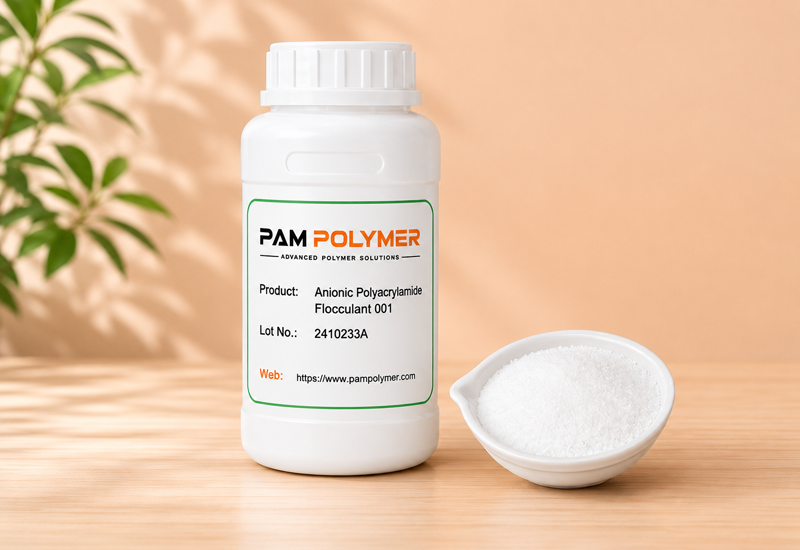
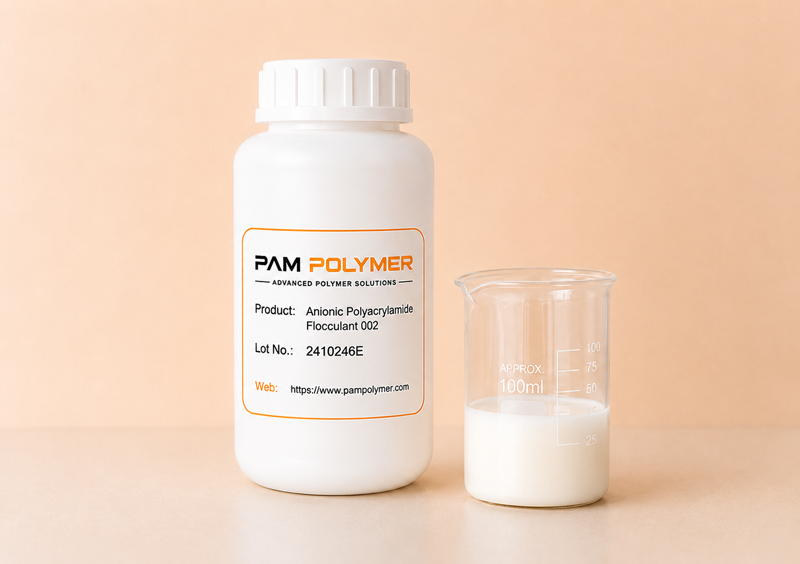
As one of the best anionic polyacrylamide manufacturers from China, PAMPolymer can supply anionic polyacrylamide flocculant for industrial wastewater treatment, mining process and oil & gas industry. Various anionic pam polyacrylamides for sale, contact now! PAMPolymer anionic flocculants are co-polymers of acrylamide with increasing proportions of acrylate groups, which give the polymers negative charges, and thus anionic active character, in aqueous solution. We can offer two types of products of anionic polyacrylamide powder and anionic polyacrylamide emulsion. Main Specifications of Anionic Polyacrylamide (PAM) Products Product Code Anionic Charge Molecular Weight Anionic PAM Powder PAMPolymer 9012 Slight Medium Anionic PAM Powder PAMPolymer 9110 Slight High Anionic PAM Powder PAMPolymer 9113 Slight/Low Medium Anionic PAM Powder PAMPolymer 9115 Low Medium Anionic PAM Powder PAMPolymer 9118 Low High Anionic PAM Powder PAMPolymer 9214 Medium Medium Anionic PAM Powder PAMPolymer 9216 Medium Medium Anionic PAM Powder PAMPolymer 9218 Medium High Anionic PAM Powder PAMPolymer 9219 Medium High Anionic PAM Powder PAMPolymer 9220 Medium Very High Anionic PAM Powder PAMPolymer 9221 Medium Very High Anionic PAM Powder PAMPolymer 9224 Medium Ultra High Anionic PAM Powder
Specifications and Product Selection
PAMPolymer 9226 Medium Ultra High Anionic PAM Powder PAMPolymer 9316 Medium Medium Anionic PAM Powder PAMPolymer 9318 Medium High Anionic PAM Powder PAMPolymer 9320 Medium Very High Anionic PAM Powder PAMPolymer 9326 Medium Ultra High Anionic PAM Powder PAMPolymer 9418 Medium High Anionic PAM Powder PAMPolymer 9426 Medium Ultra High Anionic PAM Powder PAMPolymer 9518 High High Anionic PAM Emulsion PAMPolymer 932 Medium High Anionic EPAM Oil-Free PAMPolymer 939W Medium Low/Medium Anionic Polyacrylamide Flocculants The solutions of PAMPolymer anionic polymers must be prepared in suitable plants equipped with dry powder feeding and dispersion units and with continuous and moderate agitation. The dissolution water must have a temperature included between 10% and 40%; For a correct use of PAMPolymer anionic polyelectrolyte and in order to achieve the best possible results, it is necessary to allow a “maturation” time of 60 minutes. When treating turbid water, the flocculants solution must be added to the water in a point of average turbulence, in order to achieve a thorough and homogeneous mixing without impairing the flock formation. Recommend operating concentration of anionic polyacrylamide polymer
Applications and Performance
is 3g/l, and the maximum operating concentration is 15g/l. For an optimum performance on specific applications on anionic polymer, please consult with PAMPolymer team. Above is only a brief introduction and regular specifications. For more technical details (Technical Data Sheet, Material Safety Data Sheet, Certificate of Analysis etc.) or any customized specifications, please contact us. FAQ Q: What is the Anionic Charge Range of PAMPolymer Anionic Polyacrylamide? A: PAMPolymer is supplying dry powder flocculants with anionic charge ranging from 0-100%. Q: What is the Main Characteristics of PAMPolymer Anionic PAM Polyacrylamide? A: Our anionic polymer flocculants is amorphous, free-flowing powder, with Molecular Weight: 5 to 25 million. Q: What Kinds of Polyacrylamide are Available in PAMPolymer? A: PAMPolymer polyacrylamide is available in solid, emulsion and liquid status. Q: What is the Main Application for Anionic Flocculants? A: Anionic Flocculants is widely used in Oil & Gas, water treatment, textile, printing and dyeing, papermaking, mineral processing, coal washing, medicine, sugar, breeding, building materials, agriculture and other industries. It is known as the most widely used additive. Q: What’s
Preparation, Handling and Use
the Procedure for Preparing Lab Flocculants Solution of Anionic Flocculants? A: To make the 0.3% solution, weigh 1.200g of polyacrylamide powder accurately and add into 400ml of water in a 600ml beaker. The mixer motor must be capable of maintaining 800-1000 rpm to increase the solution viscosity for 30-35 minutes. The finished solution should be clear and homogeneous. Q: What’s the Flocculation Principle? A: When polyacrylamide polymer flocculant used for flocculation, the polyacrylamide molecular chain is fixed on the surface of different particles, and the particles of each particle form a polymer bridge to make the particles form aggregates and settle. And charge group particles on the polyacrylamide molecule could have surface adsorption effect. Q: Could Anionic Polyacrylamide be Used Alone in Water Treatment? A: It mainly depends on the nature of water treated. If the impurities in the water particles larger, and with a certain charge, then the treatment performance of anionic polyacrylamide alone sometimes is good. If the impurities particles are small and non-charged, then it shall be added inorganic flocculants first and then add
PAMPolymer Supply Information
anionic polyacrylamide powder. An experiment is usually taken before answer this question. Without adding inorganic flocculants, add polyacrylamide directly to see if the impurities in the water flocculation can be flocculated. If the flocculation of water can clarify, then there is no need to add inorganic flocculants. If not then it should be used with inorganic flocculants. Q Why is Polyacrylamide Used as Flocculants? A: Polyacrylamide is most commonly used as flocculants, abbreviated as PAM. Flocculants is the linear polymer. Besides polyacrylamide solid aluminum sulfate, liquid aluminum sulfate, alum, polyaluminum chloride, ferric chloride, ferrous sulfates are also used as flocculants. Q: How to Store Anionic Polyacrylamide Properly? A: First, select a well-ventilated and dry warehouse, and to reduce the time of sunlight as the sun exposure will make polyacrylamide molecular weight degradation. Moisturizing polyacrylamide is easily to agglomerate and hard to dissolve as an aqueous solution during dissolution. If in a solution case, after the polyacrylamide dissolved in aqueous solution not used up, the remaining polyacrylamide solution should be filled with a lid seal to prevent dust from