DABC Monomer Products and Application Guide
DABC Monomer Product Overview
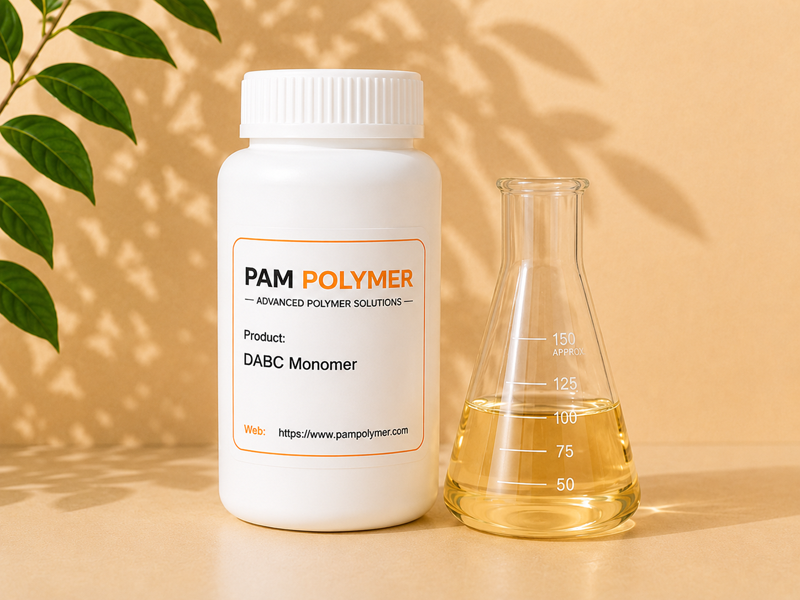
PAMPolymer provides premium DABC monomer, widely used in water treatment and other industrial processes. Our high-quality monomers enhance flocculation efficiency and offer reliable solutions for various industrial applications, ensuring optimal performance. DABC Monomer is mainly used as a comonomer for cationic polymerization, and is widely used in sewage treatment in papermaking, coal flotation, dyes, printing and other industries. PAMPolymer provides premium DABC monomer, widely used in water treatment and other industrial processes. Our high-quality monomers enhance flocculation efficiency and offer reliable solutions for various industrial applications, ensuring optimal performance. DABC Monomer is mainly used as a comonomer for cationic polymerization, and is widely used in sewage treatment in papermaking, coal flotation, dyes, printing and other industries. PAMPolymer’s high-performance retention aid for paper making increases filler/fiber retention, improves drainage, and boosts machine speed. Reduce steam consumption & enhance paper quality. Request your custom solution! PAMPolymer offers high-performance flocculants for coal washing, improving separation and recovery processes. Our products optimize sedimentation and enhance efficiency, providing reliable solutions for the coal industry while reducing operational costs. Printing and dyeing wastewater treatment is a
Specifications and Product Selection
challenging task because this wastewater usually contains a large amount of hard-to-degrade pollutants. Polyacrylamide flocculants, as a highly efficient … Printing and dyeing wastewater treatment is a challenging task because this wastewater usually contains a large amount of hard-to-degrade pollutants. Polyacrylamide flocculants, as a highly efficient treatment agent, have shown unique advantages in this field. Choosing the Right Type of Polyacrylamide Flocculants Choosing the right type of polyacrylamide flocculant is key to ensuring the effectiveness of printing and dyeing wastewater treatment. Polyacrylamide can be classified into anionic, cationic, and non-ionic types based on their ionic nature. These different types of polyacrylamide perform differently when treating printing and dyeing wastewater: Anionic Polyacrylamide Suitable for treating alkaline wastewater. Its excellent flocculation performance can effectively remove suspended solids and organic pollutants in the wastewater. Cationic Polyacrylamide Mainly used for treating acidic wastewater, it can interact strongly with negatively charged particles in the wastewater, thereby improving the flocculation effect. Non-ionic Polyacrylamide Suitable for treating neutral wastewater or used as an auxiliary flocculant. It can play a stable role under various water quality conditions. By
Applications and Performance
selecting the appropriate type of polyacrylamide, the treatment effect can be optimized according to the specific properties and treatment needs of the wastewater, thereby improving overall treatment efficiency. Controlling the Dosage of Polyacrylamide Flocculants Controlling the dosage is another important factor to achieve efficient printing and dyeing wastewater treatment. The dosage of polyacrylamide needs to be accurately adjusted based on the specific situation of the wastewater: Insufficient Dosage Will lead to poor treatment results and be unable to effectively remove pollutants in the wastewater. Excessive Dosage Although it can improve the treatment effect, it will increase the cost and may cause secondary pollution. Therefore, in actual applications, the optimal dosage range should be determined through small-scale or pilot experiments and adjusted according to actual conditions to ensure the best balance between cost-effectiveness and treatment effect. Optimizing Process Conditions To improve the treatment effect of the flocculants polyacrylamide, it is essential to optimize the process conditions. This includes adjusting the following aspects: pH Value By adjusting the pH value of the wastewater, the flocculation effect of polyacrylamide can be enhanced, making
Preparation, Handling and Use
it more effective in removing pollutants. Temperature and Stirring Intensity Appropriate temperature and stirring intensity help to improve the dispersion and flocculation effect of polyacrylamide. Filtration Medium and Filtration Speed Selecting the appropriate filtration medium and adjusting the filtration speed can improve the filtration effect, further purifying the treated water quality. By optimizing these process conditions, the role of polyacrylamide flocculants can be fully utilized, improving the efficiency and quality of wastewater treatment. Polyacrylamide Flocculants have significant advantages in printing and dyeing wastewater treatment. Their efficiency, cost-effectiveness, adaptability, and environmental friendliness make them an ideal choice for treating complex wastewater. By selecting the appropriate type of polyacrylamide, controlling the dosage, and optimizing process conditions, the treatment effect can be significantly improved. In the future, the development of new types of polyacrylamide will further promote the progress of wastewater treatment technology, making a greater contribution to environmental protection. flocculants have always played a crucial role in municipal wastewater treatment. Looking back at the development history of flocculants in recent years, the types of flocculants have continued to incr… flocculants have always
PAMPolymer Supply Information
played a crucial role in municipal wastewater treatment. Looking back at the development history of flocculants in recent years, the types of flocculants have continued to increase. In addition to the leading sales of polyacrylamide flocculants, some flocculants such as aluminum salts and iron salts are also hot-selling in the market. Today, we will list some common categories of sewage flocculants and their usage conditions. Organic polymer flocculant powder Organic polymer flocculant powder contains polyacrylamide (PAM) and activated silica. PAM is a water-soluble polymer, insoluble in most organic solvents and primarily used for bridging. Its adsorption effect is stable, and the effective pH range is 7–14. It is generally used in conjunction with inorganic flocculants. Excessive dosages can lead to reverse solubility. Cationic polyacrylamide flocculants are used for activated sludge, while anionic polyacrylamide flocculants are used for physicochemical sludge. Non-ionic polyacrylamide flocculants are not suitable for both anionic and cationic effects. Activated silica is primarily used for bridging in low-temperature and low-turbidity water. It should be added after mixing and coagulating, and the preparation process is relatively complicated with suitable