

PolyDADMAC 40% is a cationic polymer coagulant grade listed for industrial wastewater treatment and decolorization evaluation. Review the supplied specification, including the content basis and viscosity test conditions, when comparing grades. Assess performance on representative effluent using the intended mixing and separation process. The concentration designation alone does not establish a treatment dosage, color-removal percentage or operating cost. Provide the wastewater analysis and required outlet quality when requesting product details.
Grade: 40% content, low to high viscosity
Main use: industrial wastewater and decolorization
PolyDADMAC 40% is a cationic polymer coagulant grade listed for industrial wastewater treatment and decolorization evaluation. Review the supplied specification, including the content basis and viscosity test conditions, when comparing grades. Assess performance on representative effluent using the intended mixing and separation process. The concentration designation alone does not establish a treatment dosage, color-removal percentage or operating cost. Provide the wastewater analysis and required outlet quality when requesting product details.
| Product Category | PolyDADMAC |
| Formula / Type | Poly(diallyldimethylammonium chloride) |
| CAS No. | 26062-79-3 |
| Grade | 40% content, low to high viscosity |
| Appearance | colorless to light-yellow liquid or solid |
| Application | industrial wastewater and decolorization |
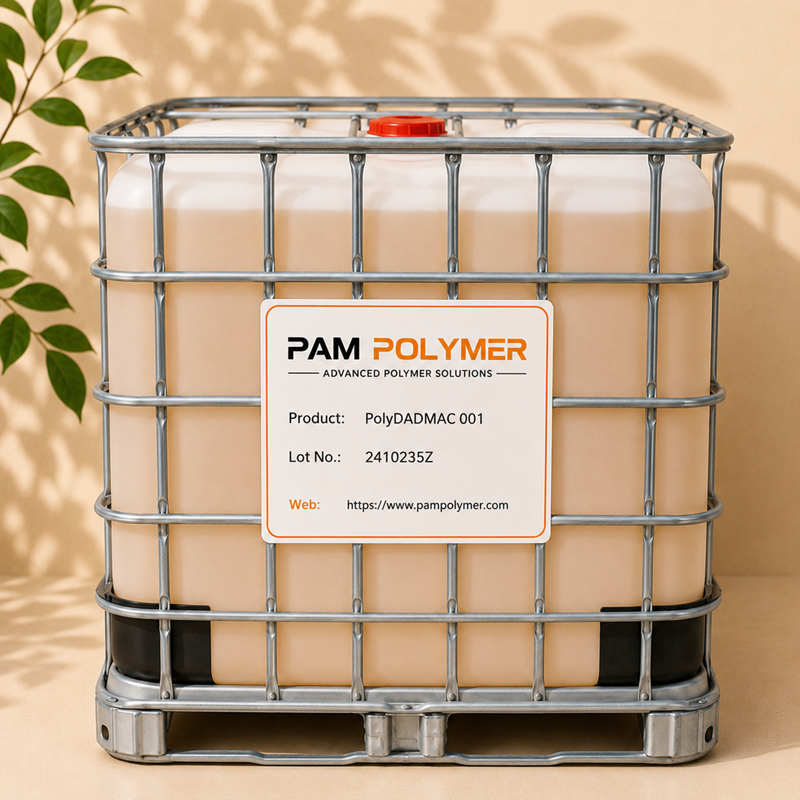
| Packaging | drums, IBC tanks or bags |
Products | Content (%) | Viscosity |
Coagulant, PolyDADMAC | 20% | Low, Medium, High |
Coagulant, PolyDADMAC | 40% | Low, Medium, High |
Coagulant, PolyDADMAC | 90% Solid | Low, High |
PolyDADMAC 40% is listed for industrial wastewater and decolorization evaluation. Define the treatment objective and sampling point before starting a product comparison.
Review the current specification for the supplied grade. Confirm the content basis, viscosity measurement conditions and handling requirements rather than inferring them from a general polymer description.
Document the wastewater source and relevant production conditions. Include samples representative of expected changes in the effluent so the trial addresses the operating range.
Use a consistent mixing procedure when comparing candidate dosages. Assess the subsequent separation stage and record the addition sequence if the programme includes other treatment chemicals.
The 40% designation identifies the listed concentration, but it does not establish performance for every industrial stream. Confirm the proposed grade against the actual contaminants, process arrangement and required results.
Compare dosage on a consistent basis using the confirmed product specification. Include residuals handling and downstream process effects when assessing cost; concentration alone does not demonstrate a saving.
Measure the parameters relevant to discharge or reuse after the intended treatment stage. Color reduction or improved settling does not establish that all applicable outlet requirements have been met.
For an enquiry, provide representative analysis, flow rate, current treatment details and available trial results. Request grade-specific documentation so the product and dosing arrangement can be assessed for the proposed application.
Send your required grade, application, packaging, quantity and destination port. PAMPolymer will reply with product details and export pricing.



Evaluate PolyDADMAC 40% against the wastewater stream and the treatment stage where it will be added. Industrial effluent may change with production batches, cleaning operations and the chemicals used upstream, so record the source and timing of trial samples. Compare candidate dosages under consistent mixing conditions and assess the intended settling or filtration stage. Where another coagulant or a flocculant is used, include the addition sequence in the trial record. Review color and other required water-quality measurements separately; a clearer sample does not establish removal of every dissolved contaminant. Confirm the product specification and handling requirements before selecting metering or dilution equipment. Use trial and plant data to compare chemical consumption, residuals handling and total operating costs. Discharge or reuse decisions should be based on the complete treatment process and the applicable outlet requirements.