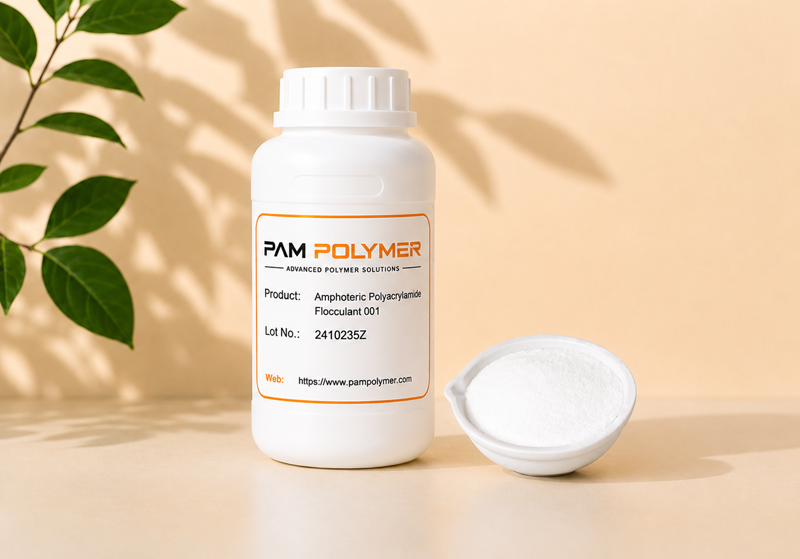
Amphoteric Polyacrylamide Flocculant Products and Application Guide
Amphoteric Polyacrylamide Flocculant Product Overview
A versatile amphoteric polyelectrolyte for industrial, municipal & oilfield water treatment. PAMPolymer’s Amphoteric PAM handles charged contaminants efficiently. Discover the right flocculant PAM for your needs. Contact us for a quote! PAMPolymer amphoteric flocculants are partially hydrolyzed polyacrylamide with high molecular weight. This amphoteric polyacrylamide is easily to remove both the positive and negative charged contents particles in a suspension solution. Main Specifications of Amphoteric Polyacrylamide (PAM) Products Product Code Cationic Charge (%) Anionic Charge (%) Molecular Weight (Million) Amphoteric PAM Powder PAMPolymer 502 Low Medium High Dosage and Feeding of Dry PAM Amphoteric polyacrylamide also called zwitterionic polyacrylamide or dipolar ionic polyacrylamide. The molecular chain of the amphoteric flocculant has two or more functional groups, of which have at least one anionic charge and one cationic charge. Unlike other mono-ionic polyacrylamides that only form either a cationic or anionic charges, the amphoteric polyacrylamide simultaneously has both ionic states. Amphoteric polyacrylamide is copolymerized by acrylic cationic monomer and acrylamide monomer. The anionic charge forms after the hydratization of the acrylamide monomer, and the cationic charge forms from the acrylic monomer.
Specifications and Product Selection
Thus, the amphoteric polyacrylamide has both positive and negative charges on its molecular chain. Above is only a brief introduction and regular specifications. For more technical details (Technical Data Sheet, Material Safety Data Sheet, Certificate of Analysis etc.) or any customized specifications, please contact us. Main applications of Amphoteric Flocculants PAMPolymer amphoteric flocculants could be used for municipal wastewater treatment and industrial wastewater treatment. Our products have both anionic and cationic charges on the same macromolecule and could be used to remove both positively and negatively charged contaminant in suspensions. 1. Industrial water treatment Amphoteric polyacrylamide has been widely used for industrial water treatment, oil refinery plants and mining etc. Amphoteric polyacrylamide has a better performance and efficiency than the mono-ionic polyacrylamide, especially when the water condition is complicated, or the water condition is keep changing, because its ability to decrease the surface tension of the water is way better. And the performance is stable when the water condition changes. In some special cases, it usually needs to use anionic flocculants and the cationic flocculants synchronously to reach a better
Applications and Performance
effect of the clarification, however, these added anionic flocculants and the cationic flocculants could react with each other and form precipitation and then lead a poor flocculate result. The amphoteric flocculants could easily avoid the problem due to its zwitterionic nature. It could create both charges without casing precipitation. And it is even easier to operate during the treatment, time saving and labor saving. 2. Municipal water treatment As the municipal waste water also has more and more complicated composition, the sludge dewatering requires a higher performance agent. At this circumstance, the simply cationic flocculants is not suitable any more, instead many tests and feedbacks show the amphoteric agent works very well. 3. Oilfield The newly developed application is for the oilfield, facts prove that amphoteric polyacrylamide could be used for profile control, water plugging, friction reduction and also the treatment for the fluid. Packaging – Storage In 25 kg Kraft bags or PE valve bags or 750 kg big bags. The product should be kept dry place and the storage temperature is 0°C to 35°C, away from direct sunlight and
Preparation, Handling and Use
moisture. Products Feeding The solutions of PAMPolymer amphoteric polymer must be prepared in suitable plants equipped with dry powders feeding and dispersion units and with continuous and moderate agitation. The dissolution water must have a temperature included between 10% and 40%; For a correct use of PAMPolymer amphoteric polyelectrolyte and in order to achieve the best possible results, it is necessary to allow a maturationtime of 60 minutes. When treating turbid water, the flocculants solution must be added to the water in a point of average turbulence, in order to achieve a thorough and homogeneous mixing without impairing the flock formation. Recommend operating concentration is 3g/l, and the maximum operating concentration is 15g/l. For an optimum performance on specific applications on amphoteric flocculants, please consult with PAMPolymer team. FAQ Q: What is the Charge Range of PAMPolymer Amphoteric Polyacrylamide? A: PAMPolymer is supplying amphoteric powder flocculants with cationic charge of 5-10% and anionic charge of 20-30%. Q: What is the Main Characteristics of PAMPolymer Amphoteric Polymer? A: PAMPolymer amphoteric polyacrylamide is formed by the acrylamide and cationic monomer.
PAMPolymer Supply Information
The product chain not only has the “carboxyl anion” after the hydrolysis of acrylamide, but also has a vinyl positive charge. Therefore, the amphoteric polyelectrolyte which has both positive and negative charges on the molecular chain is formed. Q: What’s the Relationship between Amphoteric Polyacrylamide and Cationic/Anionic Polyacrylamide? A: The amphoteric polyacrylamide (PAM) is not a mixture of anionic and cationic. If the cationic polyacrylamide bejing used in together with anionic polyacrylamide, the precipitation will be formed. Amphoteric polyacrylamide is a molecule containing both cationic and anionic groups. Q: What are Dissolving Tips for PAMPolymer Amphoteric Flocculants? A: The water to dissolve polymer should be clean not sewage, such as tap water. The water at the normal temperature will not need to be heated. Q: What’s the Main Application for Amphoteric Flocculants? A: Amphoteric Flocculants is widely used in sludge treatment like biochemical sludge and dehydration, industrial sewage treatment in EOR and dewatering of dehydrated organic sludge, organic sludge treatment in domestic sewage treatment plant, paper mill. Q Can Amphoteric Polyacrylamide Be Used in Paper Industry?