

PolyDADMAC 20% is a cationic polymer coagulant grade listed for water-treatment evaluation. Confirm the supplied product specification, including the concentration basis and viscosity test conditions, before comparing it with other grades. Select a trial procedure that reflects the source water and intended clarification stage. The 20% designation alone does not establish the operating dosage or the suitability of the grade for personal-care, textile or other non-water-treatment applications.
Grade: 20% content, low to high viscosity
Main use: water treatment and coagulation
PolyDADMAC 20% is a cationic polymer coagulant grade listed for water-treatment evaluation. Confirm the supplied product specification, including the concentration basis and viscosity test conditions, before comparing it with other grades. Select a trial procedure that reflects the source water and intended clarification stage. The 20% designation alone does not establish the operating dosage or the suitability of the grade for personal-care, textile or other non-water-treatment applications.
| Product Category | PolyDADMAC |
| Formula / Type | Poly(diallyldimethylammonium chloride) |
| CAS No. | 26062-79-3 |
| Grade | 20% content, low to high viscosity |
| Appearance | colorless to light-yellow liquid or solid |
| Application | water treatment and coagulation |
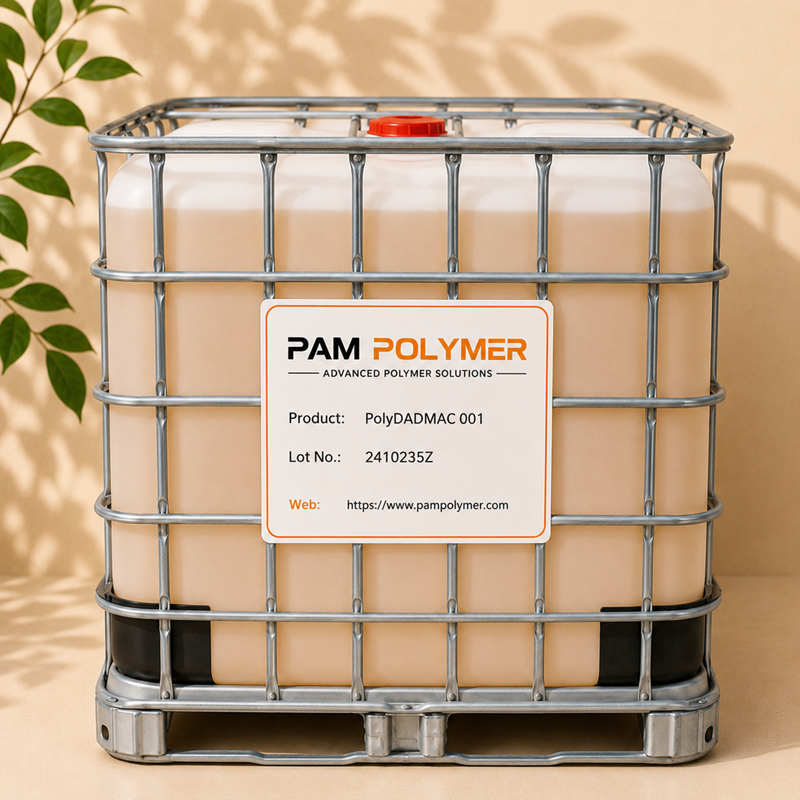
| Packaging | drums, IBC tanks or bags |
Products | Content (%) | Viscosity |
Coagulant, PolyDADMAC | 20% | Low, Medium, High |
Coagulant, PolyDADMAC | 40% | Low, Medium, High |
Coagulant, PolyDADMAC | 90% Solid | Low, High |
PolyDADMAC 20% is listed as a coagulant grade for water-treatment evaluation. Select the product against a defined water stream and treatment objective.
Confirm the supplied specification before using physical-property values to select equipment or storage conditions. The concentration designation does not establish viscosity, freezing point or other grade-specific properties.
This page concerns water treatment and coagulation. Uses associated with other PolyDADMAC grades, including personal-care or textile formulations, should not be assumed to apply to the supplied product.
Request current packaging, shelf-life, storage and transport information from the supplier. Use the safety data sheet for the actual grade when planning handling arrangements.
For a useful product comparison, define the trial conditions and the required measurements before testing.
1. Evaluate the actual operating pH and source-water conditions rather than assuming performance across an unspecified range.
2. Compare dosages using consistent mixing and separation procedures, recording the addition sequence where other chemicals are used.
Send representative water analysis, flow rate, existing treatment details and the required outlet quality with an enquiry. Assess compatibility and performance through the proposed trial programme; the product name alone does not guarantee the result.
Send your required grade, application, packaging, quantity and destination port. PAMPolymer will reply with product details and export pricing.



Review PolyDADMAC 20% as part of a defined coagulation and separation programme. Use representative water samples and record the existing treatment chemicals, mixing conditions and measurement point when comparing dosages. Where another coagulant or a flocculant is used, evaluate compatibility and addition sequence rather than assuming interchangeable performance. Confirm the concentration basis in the supplied specification when comparing product consumption with a different grade. Request current supplier documentation for storage conditions, shelf life, packaging and transport classification. Values copied from a general polymer description should not be treated as specifications for the supplied product. For an enquiry, provide source-water analysis, flow rate, the existing treatment arrangement and the required outlet quality. Any drinking-water application also requires review of the approvals and use conditions applicable to the actual grade.